
The Stitch That Doesn’t Exist
Amigurumi Style Tattoos and the Illusion of Thread
I've been hyper-focused lately on Amigurumi-style tattoos. That knitted look really has you paying attention to how it's done because the longer you stare at them, the more your brain starts arguing with your eyes. You know you're looking at skin, and there isn't a single piece of yarn involved. Yet somehow the artist convinces you that somebody stitched a stuffed animal directly into another human being.
Good tattooing has always been built upon deception. Black and gray artists create depths that don't exist. Realism artists make flat skin look like photographs. Traditional artists create movement with nothing more than line weight and color. Amigurumi tattoos take the deception to another level because they force the viewer to believe something they already understand with their hands. Everyone knows what yarn feels like, with the softness of a blanket, the texture of a knitted sweater, the raised pattern of stitching, and the slight imperfections that tell us something was made by another human being. The artist now must create all those sensations without any actual texture existing on the skin.
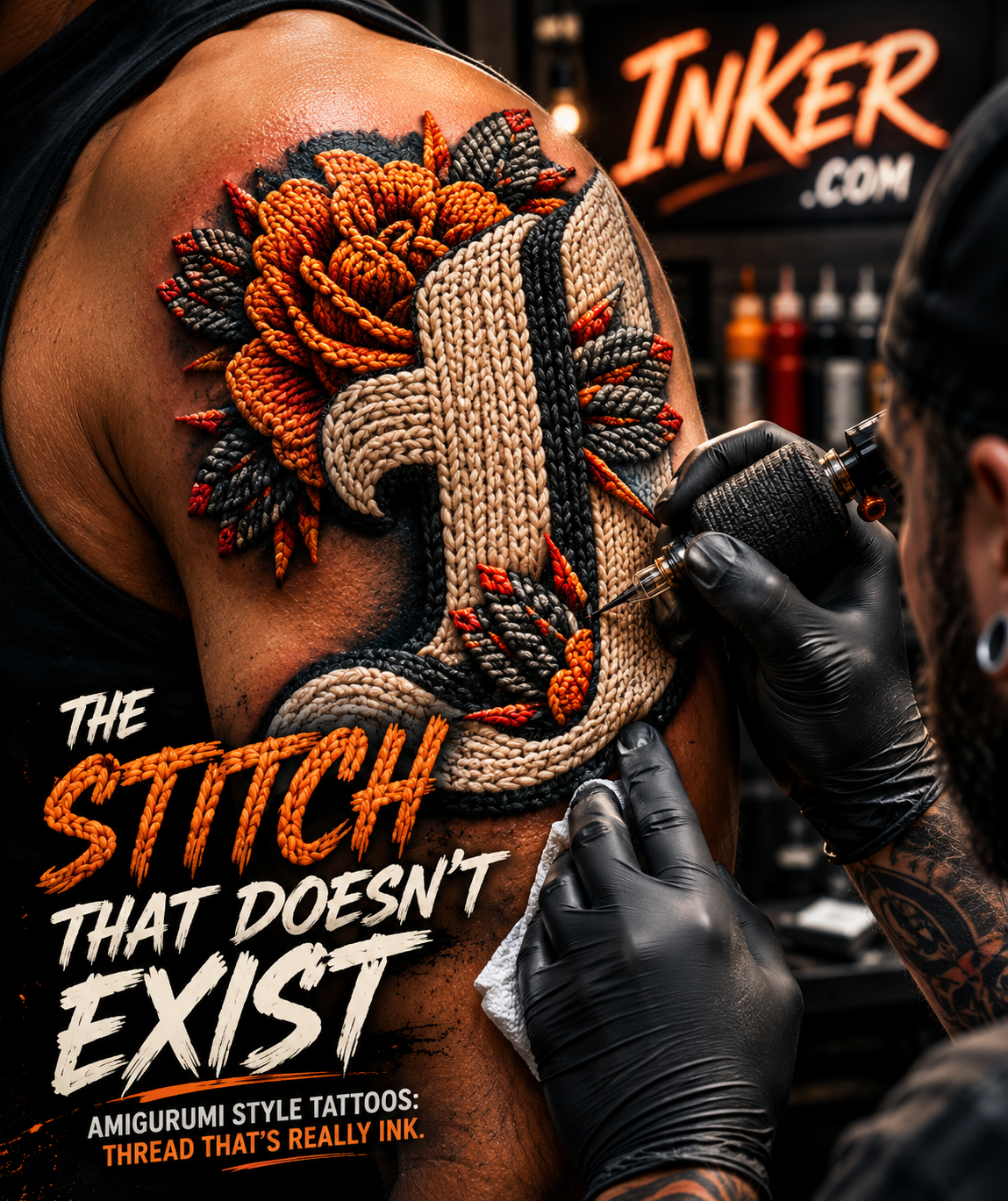
The style itself originates in Japan. The word combines ami, meaning knitted or crocheted, and nuigurumi, meaning stuffed doll. The movement became increasingly popular during Japan's postwar period before exploding worldwide during the rise of kawaii culture throughout the 1980s and 1990s. Small crocheted animals, dolls, and characters became symbols of handmade craftsmanship and comfort in an increasingly technological world. Somewhere along the way, tattoo artists looked at a stuffed toy and apparently said, “I wonder if we can tattoo that.”
The answer turned out to be yes, although the amount of technical ability required is far greater than most people realize. Every stitch must appear consistent, and every loop has direction. Shadows must convince the eye that one thread sits above another. Highlights become majorly critical because they create the illusion of depth between rows of yarn. Too much contrast destroys the effect while too little contrast flattens the image. The artist isn't simply drawing a stuffed animal, they're drawing the illusion that the stuffed animal is made of yarn.
That is what keeps pulling me back to these tattoos. Somewhere between the stencil and the finished piece, the artist becomes less of a tattooer and more of an illusionist. The skin remains perfectly smooth, yet your brain insists the tattoo should feel soft. You almost want to reach out and touch it because your eyes are telling your hands that something knitted is sitting on top of the body.
As I started looking deeper, another thought occurred to me. Tattooing has spent most of its history trying to imitate hard things, like metal, stone, skulls, machinery, even architecture. Realism often focuses on sharp details and hard edges. Amigurumi turns the entire equation upside down by asking artists to tattoo softness. The objective isn't to make something look heavy, dangerous, or permanent. It's to make the viewer believe they are looking at yarn, thread, fabric, and something handmade.
There is also something strangely human about it. In a world filled with artificial intelligence, digital artwork, filters, and endless screens, these tattoos celebrate something intentionally imperfect. The original Amigurumi figures were handmade. They carried the flaws, inconsistencies, and small details that only human hands could produce. Tattoo artists are now recreating those imperfections with needles, ink, and skin.
Maybe that's why the style keeps grabbing my attention. The tattoo doesn't simply show a stuffed animal. It shows patience, texture, craftsmanship, and most importantly, it makes another artist stop, stare, and ask the same question…...How did they do that?
At Inker.com, we spend a lot of time looking at tattoo styles that force artists to slow down and study the work. Sometimes the most impressive tattoo in the room isn't the biggest sleeve, the darkest black and gray piece, or the most expensive realism project. Sometimes it's a six-inch stuffed bear that somehow convinced your brain it was knitted by somebody's grandmother and sewn directly into another human being.