The Social Media Slot Machine Is Quietly Owning Tattoo Artists
Why Attention Is Not a Business Model
One of the most dangerous things happening in the tattoo industry today has nothing to do with bad tattooing, oversaturation, or competition. It is the growing number of artists who have unknowingly handed control of their businesses to an algorithm they neither understand nor control. Social media was originally another avenue for artists to showcase their work and reach potential clients. Somewhere along the way, however, that tool slowly became the business itself, and many artists now spend more time chasing engagement than building the very foundation that keeps a career alive.
The comparison that keeps coming back to me is a slot machine because the psychology is remarkably similar. Every time an artist uploads a reel or posts a fresh tattoo, there is hope that this one will finally be the breakthrough. Maybe it will reach hundreds of thousands of people, bring in a wave of new clients, or generate enough likes and comments to create the feeling that everything is finally moving in the right direction. The next post receives a fraction of the attention, leaving the artist wondering what changed.
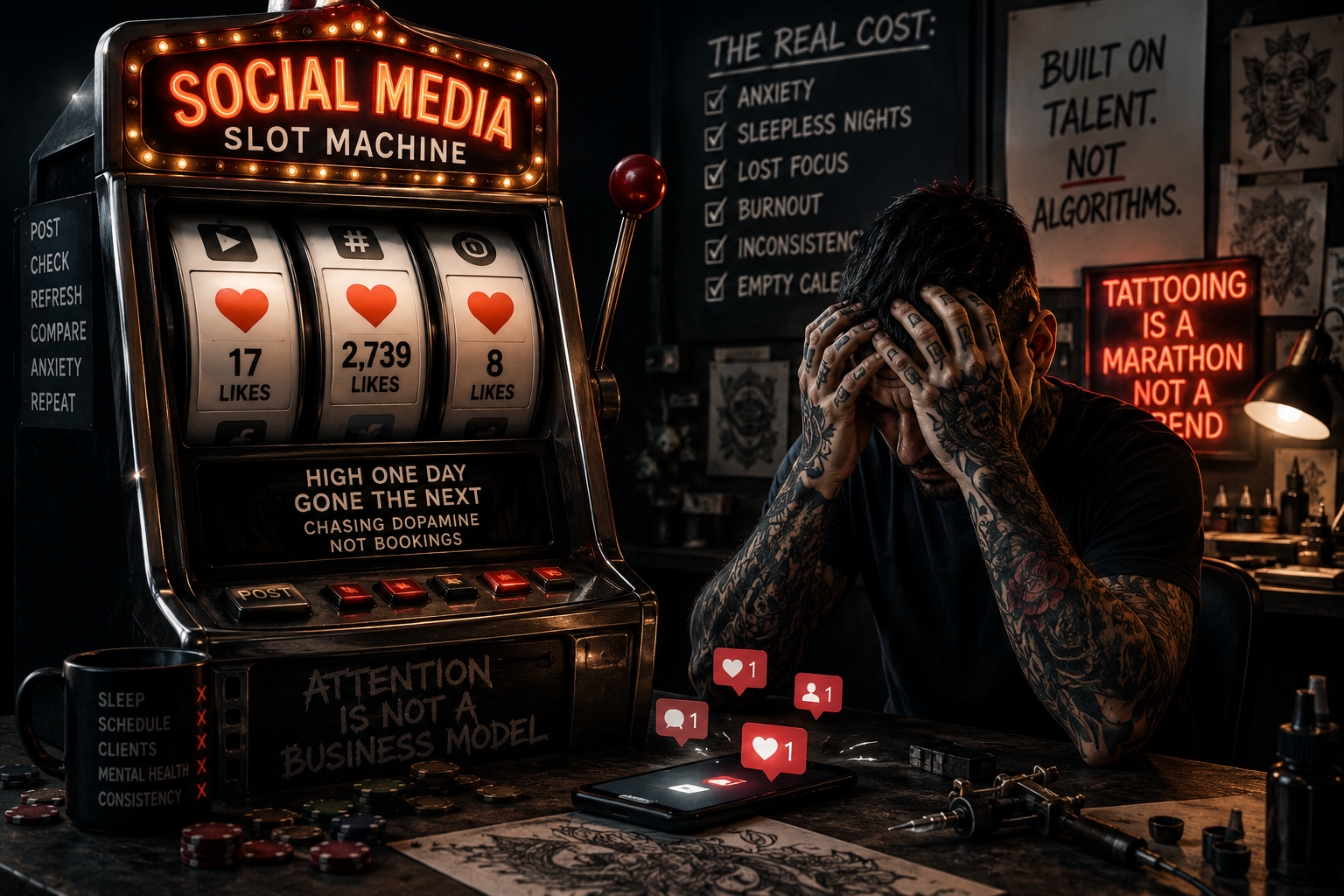
Instead of stepping back and questioning the business strategy, the natural reaction becomes pulling the lever again. Different music, hashtags, additional editing, or changing the posting time. The hope is always that the next spin will finally pay out.
What concerns me most is what I continue hearing directly from artists. During my visits to tattoo shops and conventions, more than one artist has shared something they probably don't say publicly. They've told me their anxiety has become overwhelming because of social media. They've admitted there are nights when they cannot sleep because they keep wondering why one post succeeded while another disappeared. They've described checking their phones over and over throughout the day, watching numbers that ultimately have little connection to the quality of their work. When talented professionals begin questioning years of dedication because software decided not to distribute a post, something has gone terribly wrong.
Before anyone objects, let me be clear. I am not arguing that social media has no value. It has tremendous value when it's treated as one component of a larger marketing strategy. The mistake is believing that it is the strategy. Those are two very different things. An artist who builds an entire business around a platform they do not own has accepted a level of risk that most would never tolerate in any other part of their career.
Imagine opening a tattoo studio on property where the landlord could arbitrarily change the rent every week, move the front door without notice, decide whether customers are allowed inside, and refuse to explain any of those decisions. No rational business owner would knowingly accept those terms, yet thousands of artists willingly operate under exactly those conditions every single day online.
The most successful artists I have met all have one thing in common, and it has very little to do with follower counts. They understand that a career is built through reputation, relationships, referrals, consistency, and trust accumulated over years. Their clients return because of the experience they receive, not because a reel reached a million views. Their calendars remain full because former clients become advocates, not because an algorithm happened to reward a particular post on a Tuesday afternoon.
Likes have never paid rent, nor have views purchased supplies, and followers have never guaranteed deposits. Those numbers can certainly create opportunities, but opportunities and businesses are not the same thing. A business is something that continues functioning even when the internet decides not to cooperate. If an artist's appointment book rises and falls with every algorithm update, then the platform is no longer serving the artist, it's serving the platform.
If there is one observation, I hope artists take from this article, it's that every hour spent chasing unpredictable engagement should be weighed against the hours spent building assets that cannot be taken away by a software update. Strengthening relationships with existing clients, asking for referrals, improving your consultation process, attending community events. Give people reasons to remember your name outside of an app that is designed to keep them scrolling.
Social media should absolutely be part of the marketing mix, but it should never become the foundation upon which an entire career depends. Slot machines are designed to make people believe the next pull might change everything. Successful businesses are built on systems, relationships, and decisions that continue producing results long after the excitement of the next spin has faded.
That's one of the reasons I became interested in what Inker is building.
What caught my attention wasn't another booking platform or another social media app. It was the idea that artists should have more than one path for clients to discover their work. Every business becomes stronger when it diversifies where its customers come from. Investors diversify portfolios, businesses diversify revenue streams. It seems only logical that tattoo artists should diversify how clients find them.
No single platform should have the ability to determine whether your books stay full. Social media has earned its place, but it should be one lane, not the entire highway. A healthy business is built on referrals, reputation, search visibility, local relationships, repeat clients, and yes, social media. Remove any one of those and the business should continue moving forward.
If this article causes even a handful of artists to spend less time chasing the next viral post and more time building a business that can survive regardless of what an algorithm decides tomorrow, then it was worth writing. Your talent deserves a stronger foundation than a slot machine, and your career deserves better odds than hoping the next spin finally pays out.